4th August 2024
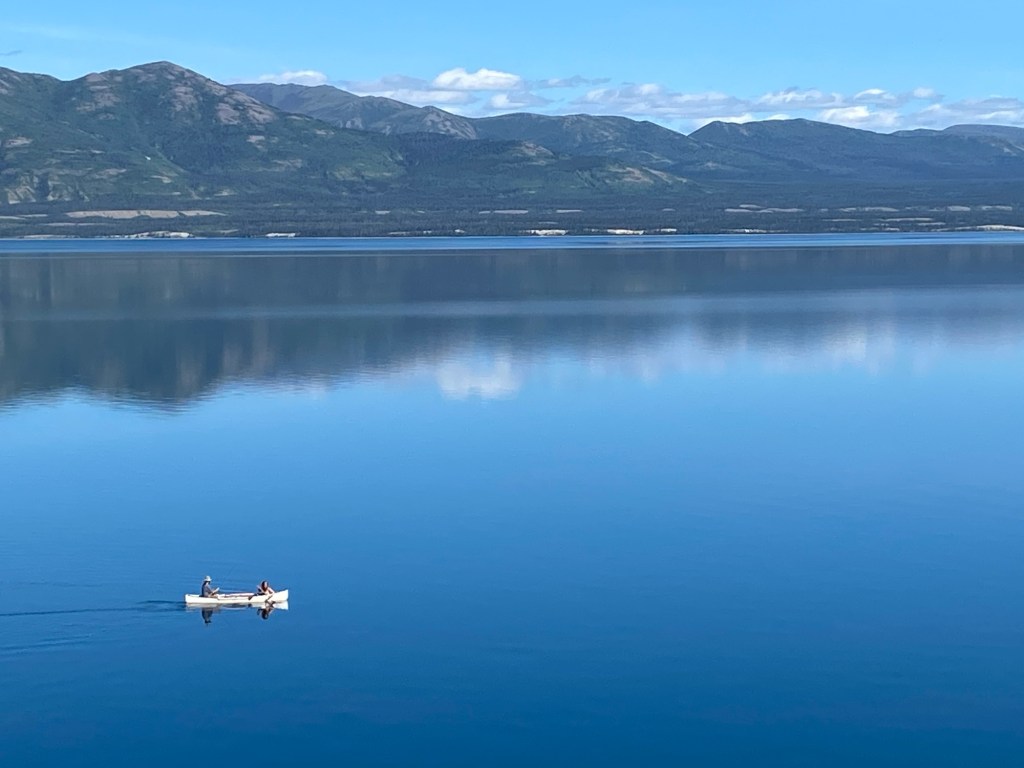
Time is rushing by. It’s been a busy few days. It is said that adventure begins at the edge of your comfort zone – well, by that definition yesterday was certainly an adventure! And it feels great.
We have been riding around south and east of Anchorage, and achieved the goal of reaching the furthest western point of North America accessible by road, at Anchor Point. This was five weeks after we were at the most eastern location at Spear Point in Newfoundland. Job done. Except that there’s always more. I don’t know if I’m going to be coming back to Alaska, although I’d like to it is a very long way away. It is a wonderful and beautiful state, and as harsh a place to live as any that I’ve visited. It feels a long way from the mainstream of the east and west coasts of the lower 48 states, and I can understand why the national and international politics of Washington seem of little relevance. People are here because they enjoy the isolation and lifestyle that entails. And they are likely to resent attempts to put limits on that. Whether the lifestyle bears any resemblance to what made America great is another matter entirely.
Val flew home from Anchorage, and Al reluctantly decided to get home too. It was a sad end to his trip, we were all sorry to see him go. I hope to have another trip with him one day though.
We were now down to three. There are several remote communities to see here; we rode to the Halibut fishing capital of Homer which is just a little way beyond Anchor Point, and from there to the oil terminal at Valdez.
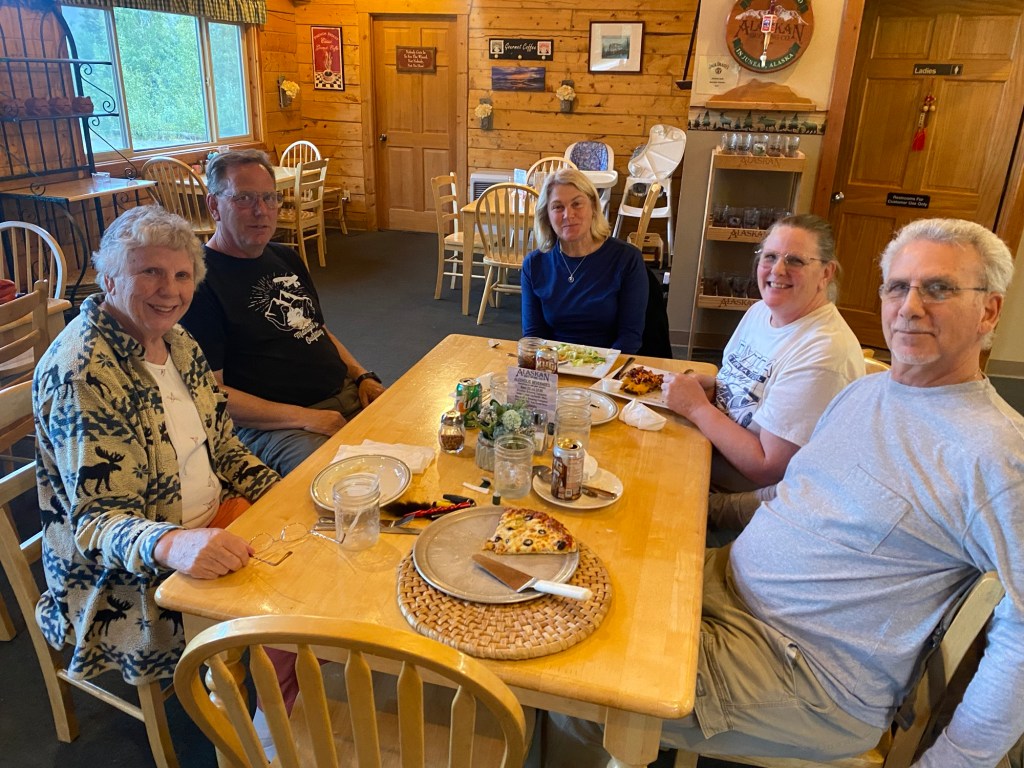
There are many things one can say about Alaska, it’s remoteness, it’s rugged mountainous terrain, it’s northernness, straddling the Arctic Circle and it’s wildlife, of which I have seen disappointingly little. But one thing that stands out is the people who choose to live here, and their incredible generosity. Some examples from the last four days: Dave and I were riding east from Anchorage towards Valdez, and stopped overnight to camp in a remote area called Glacier View (no prizes for guessing why). There was a cafe, run by a totally charming family who had originated in the Far East who served an excellent dinner. We had just about finished when someone reached over and took the bill away – I assumed to add the glass of red wine that Dave had asked for. Then a lady from the table behind me said that she always liked to do something nice every day and she had paid for our meal in its entirety. We were dumbfounded, and tried to hide our embarrassment – she was genuinely kind.
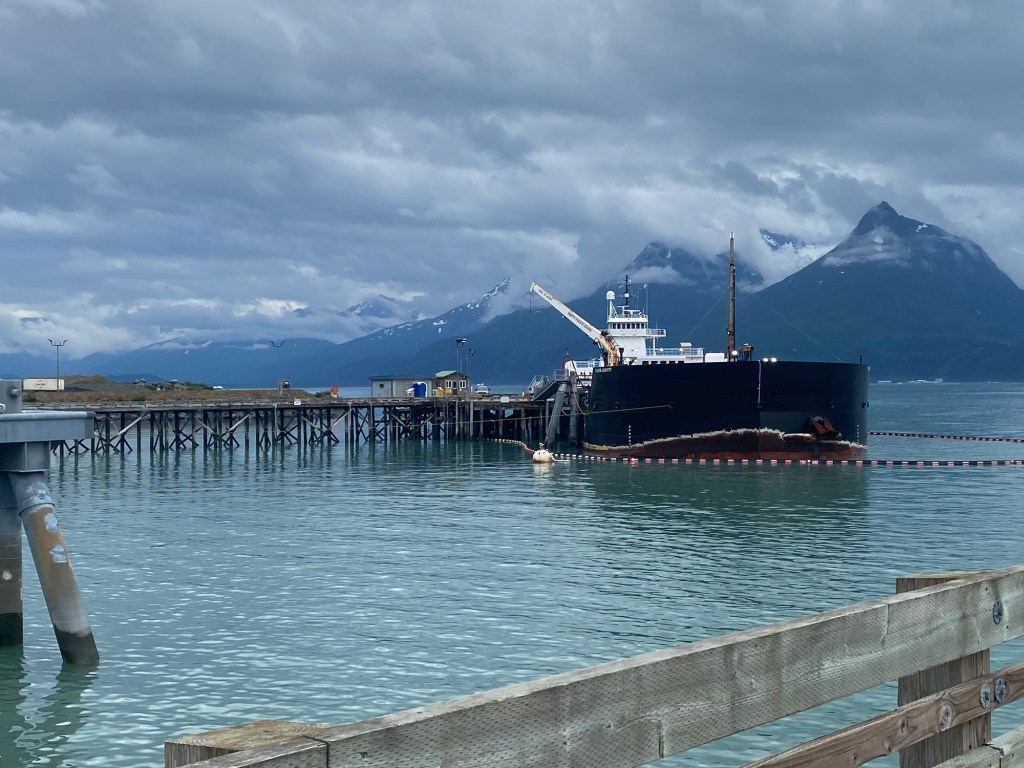
Valdez is somewhere I’ve always been fascinated by, although I know of it mainly because of the oil tanker disaster involving the Exxon Valdez, and also the annual World Extreme Skiing Championship held here, in the Chugach Mountains. I’ve seen the beginning of the Trans-Alaska oil pipeline in Prudhoe Bay, so it was interesting to see its termination 800 miles later.
With no affordable accommodation available in Valdez we headed back northward. A cabin was found at a fishing campground at a tiny old village called Copper Center, on the banks of the Copper River.
The cabin was rustic in the extreme, but adequate for the three of us. But what made it special was the fact that we had stumbled across one of the prime spots for Sockeye salmon in the world – The Copper River is known for its pristine waters and strong currents, which contribute to the development of healthy and flavorful salmon. The fish are high in omega-3 fatty acids and have a rich, buttery texture that is highly prized by chefs and seafood lovers. Copper River Sockeye salmon are sought after for their delicious taste and are considered a delicacy in the culinary world. The lady who runs the place offered us lessons in fishing (for $180 per person) and we would be guaranteed to catch one, if not several. I’m not really into fishing, but if only we had more time (and money!). We walked into the village for a rudimentary supper, when we returned to the cabin we found about two kilos of fresh salmon on the doorstep. Our hostess had left it for us, as she thought we ought to try it. Although there was a barbecue outside the cabin, it is a matter of great regret that nobody felt like salmon for breakfast, and we really couldn’t take it with us. So all I could do was leave it in the fridge and offer profuse thanks.

To go from Anchorage back to Canada one has to go back north first. Looking at a satellite image reveals why.
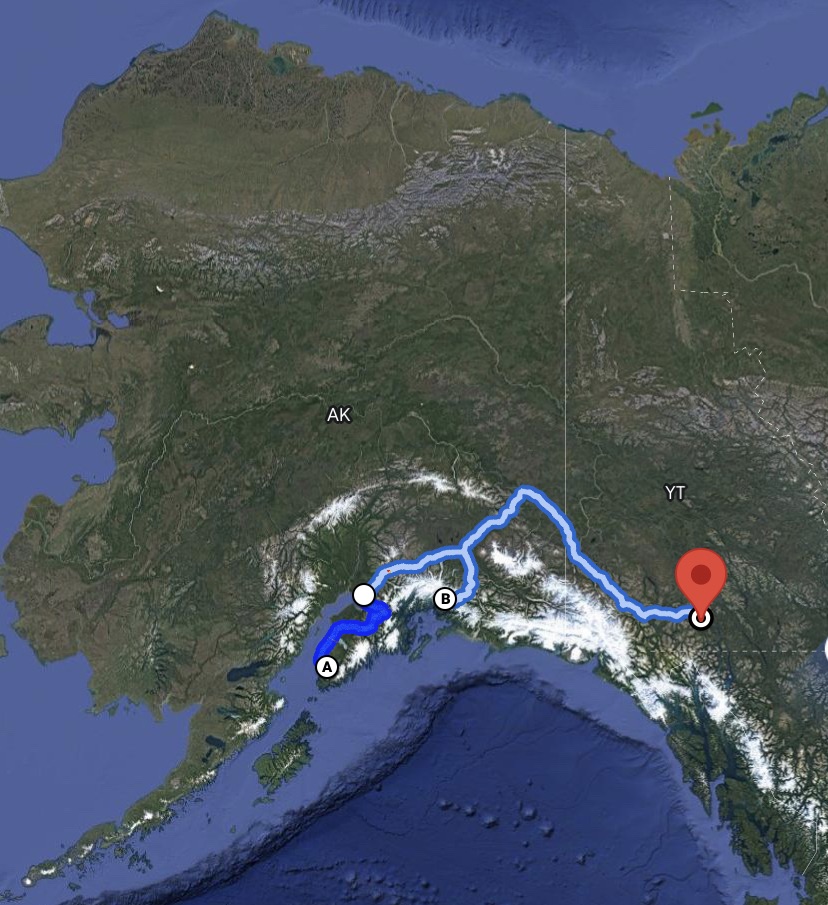
The huge expanse of white on the satellite image between Valdez and Whitehorse is made up of the Wrangell Mountains, the St. Elias Mountains, and the Chugach Mountains with their towering peaks, massive glaciers, deep valleys, and diverse ecosystems. These form the largest National Park in the US. Numerous peaks stand over 4,877 metres high, Mt St Elias is the second highest peak in North America at 5489 m. The tallest is Mt McKinley (aka Denali) at 6190 m, which we failed to see a week previously as it was covered by dense clouds.

There are no roads crossing this area. Thus the road out takes one up to Tok, north of the mountains, before heading back south and east into Canada. However, I had noted on a roadmap that there is in fact a road that goes some way into the National Park, and had heard from other travellers that it was well worth exploring. So what were we to do?
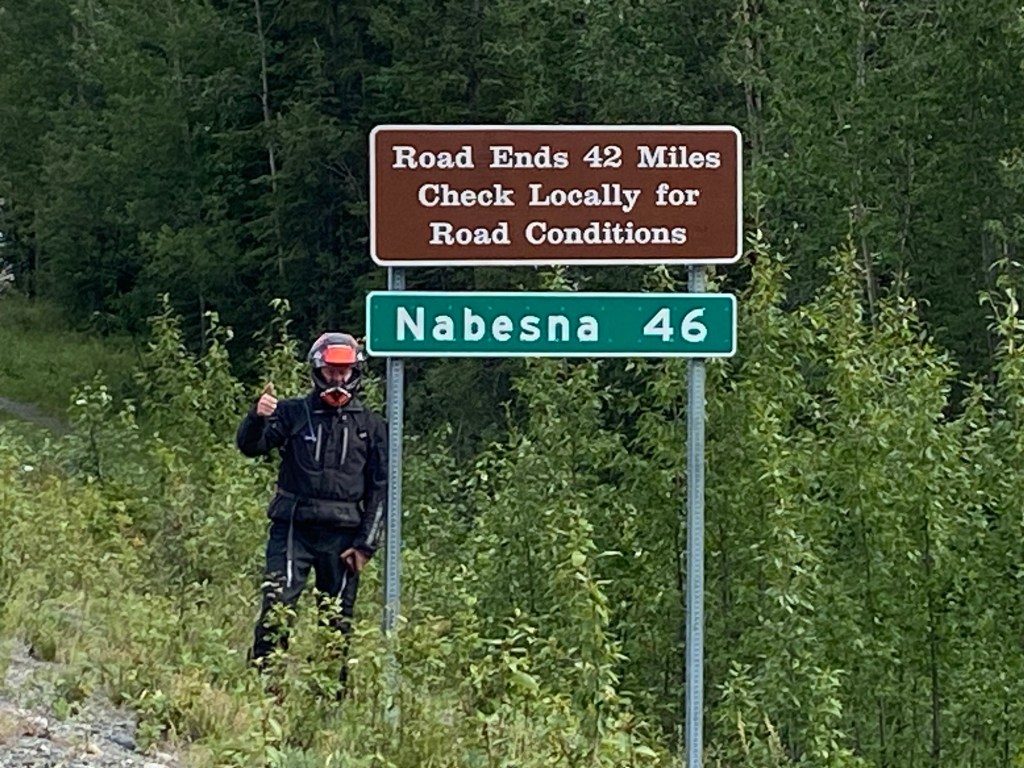
Chris and I set off down the side road. It started out as tarmac but soon became gravel, winding through dense forests. The gravel became rockier and more uneven, the only way to negotiate it was by standing on the pegs and keeping the power on. Speed can be your friend, at the same time as magnifying the consequences of a fall. I was at the very limit of my comfort zone – and then we came to the first river to cross. My comfort zone was now well behind me – this was exhilarating!
The Ducati is fantastic!
We continued for over 40 miles. Expecting the “road” just end with no fanfare, we were astonished to find at its end a log cabin with the sign Devils Mountain Lodge, a BnB.
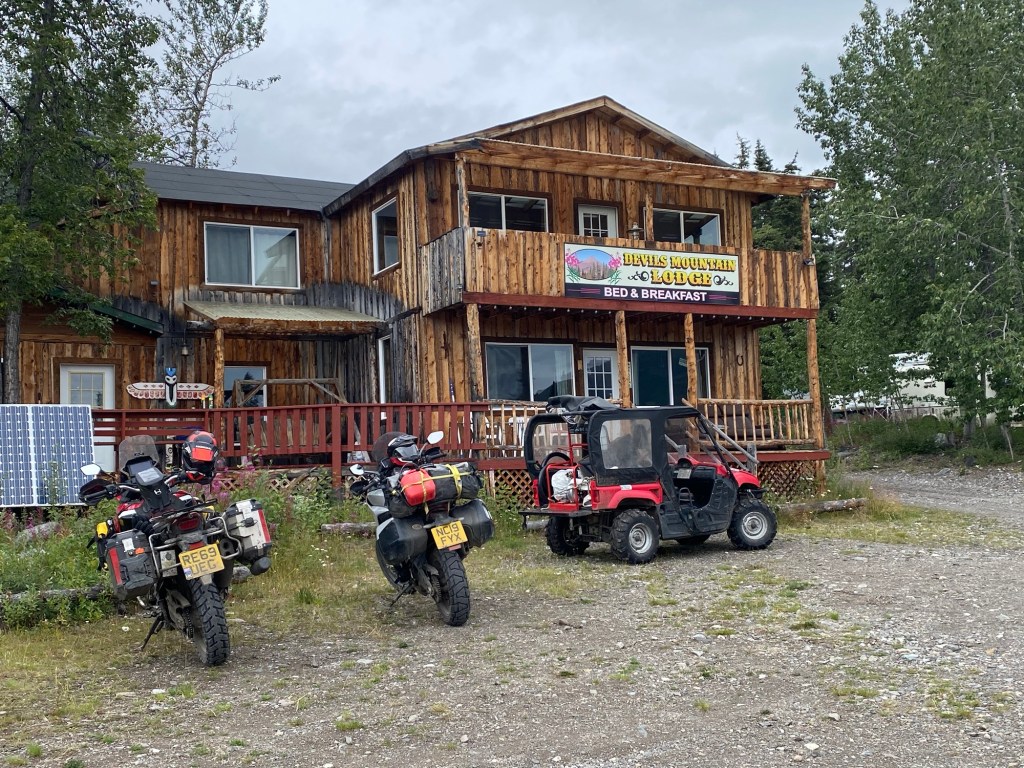
I had seen nobody for the last hour and a half, but a couple of guys were walking towards the lodge. I confirmed with them that this was indeed the end of the road – and asked if the lodge served coffee. They invited us in, and we sat and chatted for an hour or so. Kirk had been born there and had lived there all his life. His friend Greg had been born and raised in another lodge on the old Denali Highway, we had passed by his home a week previously. We had noticed outside the lodge was a small airstrip hewn out of the rough ground, and two or three small planes (with large off-road looking tyres). Kirk makes a living by providing an air taxi service, mostly for hunters and explorers. He also uses a plane to do the weekly shopping! Completely off grid until recently, they now have internet provided by the satellite Starlink service, which has transformed their connection with the outside world. Getting news has never been easy, but both Kirk and Greg professed a preference for the BBC as they felt it was the only service they could trust to be unbiased. The view we were afforded into a completely different way of life in our western world was fascinating and unforgettable. The ride to get there (and back out again) was brilliant fun, but meeting these guys made it so much more worthwhile.
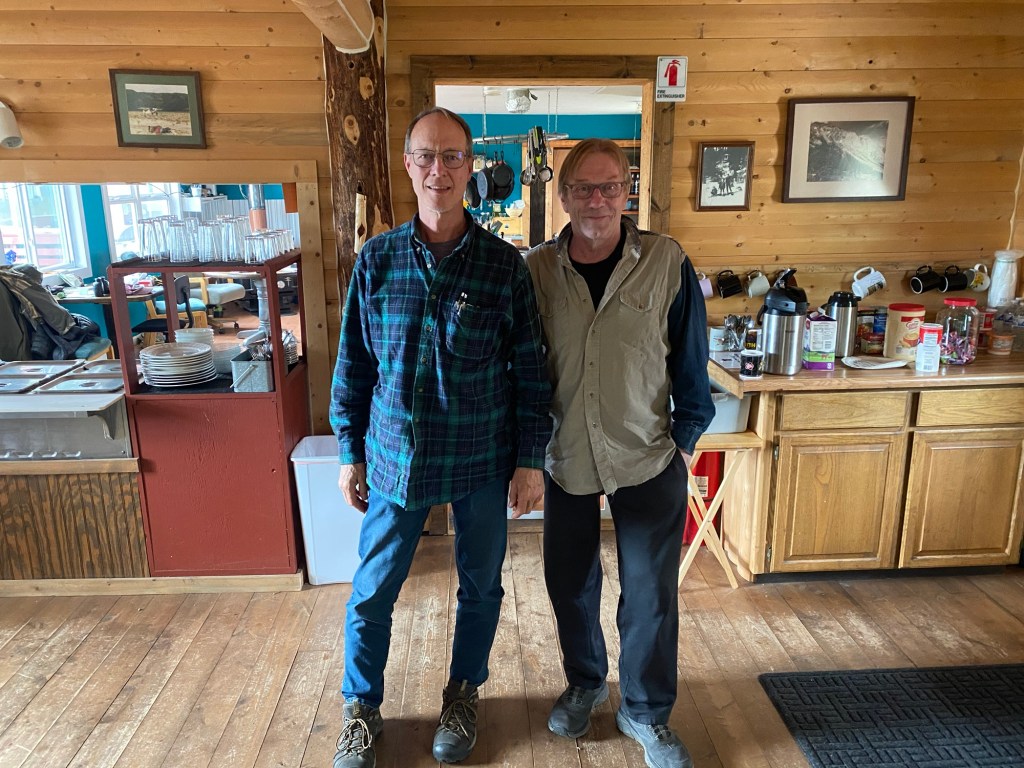
I left Greg the Blog address – if you’re reading this gentlemen, it was a great pleasure meeting you!


 Crossing Canada
Leave a comment